


No, it doesn’t. A FPC actually sits underneath them and acts as the foundational layer so that when these tools detect an attack, FPC can directly check and see what actually occurred inside the network.
The Case for Full Packet Capture: 5 Benefits Security Teams Can’t Ignore

Somewhere in your environment, there may be a connection your tools already logged and forgot about. That’s not a hypothetical.
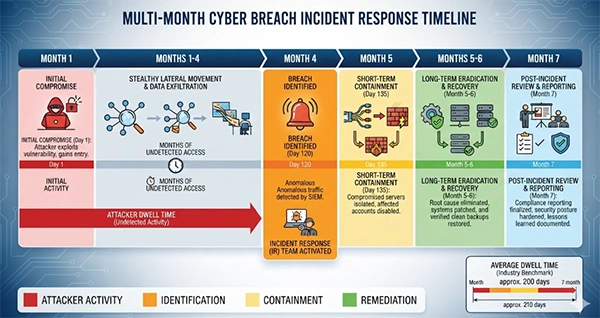
According to IBM’s 2026 Cost of a Data Breach Report, cybercriminals have successfully managed to find a way to use automation, which speeds up the process of their attacks and has increased the average cost of a breach to $5 million. The average time to identify and contain such a breach has also risen to 247 days.
Now, traditional logs only tell you who talked to whom, when, and for how long. They don’t tell you what they said, which is exactly what full packet capture targets. FPC allows you to prove which files or data were actually attacked instead of letting you assume.
Why the Evidence Gap Costs You Months
Traditional systems built for cybersecurity,y like SIEM, EDR, and firewalls, are built to summarize the attack rather than showing the actual data from it. A firewall log shows a connection was permitted. It doesn’t show what travelled across it.
And that gap is expensive. IBM’s 2026 data shows breaches contained within 200 days average $4.32 million; the ones that run longer average $5.65 million. So, detection speed doesn’t just remain a SOC metric anymore; it’s the biggest cost lever your organization has.
This is exactly the problem a full packet capture (FPC) solves. Instead of assuming a database was stolen because the connection was open for two hours, it records the traffic itself and allows analysts to reconstruct the exact files that were attacked to be downloaded, commands executed, and data exfiltrated.
What Full Packet Capture Actually Gives You
An FPC provides numerous features apart from the proof of attacks, which makes both the auditor and analyst’s job easier.
Ground Truth Instead of a Summary
A SIEM alert says a connection looked anomalous. It can’t usually say what was in it. Stored packets can. Analysts reconstruct the session, pull any file that moved, and confirm precisely what left the network instead of arguing about what an alert probably meant.
The Ability to Go Back and Look
Most dangerous indicators aren’t known at the moment they matter. A new IOC lands weeks or months after the fact, once a vendor finally names it.
Without packet history, you can only search for what you already knew to look for at the time. With it, you check whether that indicator ever touched your network, and when.
Evidence That Survives Scrutiny
NIST’s SP 800-86 guidance on integrating forensic techniques into incident response defines the standard sequence: collection, examination, analysis, reporting, with integrity preserved at every step, typically through cryptographic hashing of captures the moment they’re taken.
Packet-level evidence, handled this way, holds up somewhere a verbal account of what a dashboard showed does not.
What It Does for the Rest of Your Stack
It is impossible for a detection tool to be right all the time. Every tool, like a SIEM rule or an EDR model, throws around some false positives and negatives that most people don’t pay attention to.
That is not something that should occur within an organization because some of these false positives can be true. That’s why packets check the alerts thoroughly instead of just assuming that it’s a harmless false positive. It confirms whether the flagged portion of a run conducted by a software is real or if it was just noise.
That feedback, not another tuning workshop, is what actually improves detection accuracy over a quarter.
What It Does Come Audit Time
Compliance frameworks like PCI DSS and FedRAMP, which are designed keeping the importance of critical infrastructure in mind, reject passive data because “we believe this is what happened” doesn’t satisfy an auditor. Frameworks like these are constantly in search of proof through monitoring instead of believing data because of ‘he said, she said.’
Hence, in such cases a searchable, retained packet record is extremely beneficial. If the packet is indexed well enough, it can be used to pull data on a request instead of just accumulating it on a disk somewhere.
Deciding What You Actually Need
The true cost and value of a full packet capture system (FPC) does not depend on capture rate; it actually depends on data query. This typically means that while it is easy to capture data and write it on a disk at high speed without dropping the packet, the data altogether becomes useless if an analyst has to wait twenty minutes to retrieve a session during an active incident response.
Vendors in this space, SentryWire among them, tend to differentiate less on raw capture speed and more on how fast you can actually query months of stored traffic once you need it.
So these vendors have increasingly started to focus their point of testing on search and retrieval performance rather than relying on metrics listed in a vendor spec sheet.
Final Analysis
While tools like Security Information and Event Management (SIEM) and Endpoint Detection and Response (EDR) detect and alert an organization about an attack, FPC proves exactly what happened during that attack. So FPC isn’t just a replacement for these tools; it actually constitutes the foundational layer of any organization’s cybersecurity team. FPC also decreases the industry average time which is 247 days, for an attack to be identified and contained, which helps to save both money and important information stored in a network.
It gives the analysts proof instead of assumptions, which makes it easier for an auditor or board member to understand. So, to achieve the real value and benefits of an FPC, use the budget allotted for testing retrieval and retention from day zero.
Frequently Asked Questions
Does full packet capture replace a SIEM or EDR platform?
How long should packet data actually be retained?
The retention of FPC actually varies on your compliance and budget, though the typical duration ranges from weeks to a few months.
Accordion TitleWhat things to keep in mind while using a FPC?
You should remember that in an FPC, retrieval speed matters more than its storage. A system that can’t search its own archive quickly during an active incident isn’t solving the problem it was bought for.
Does it genuinely help with compliance audits?
Yes, where frameworks like PCI DSS or FedRAMP expect continuous monitoring evidence rather than a written description of your process.
Related Posts
How to Protect Business Data From Unwanted Scrapers
Scrapers are a well-known problem for businesses; protecting private records, discouraging unwanted bulk copying, and preserving access are topics one…
Your Email is Data Too: Testing AI Tools That Work Without an Account
People who read about data recovery are most likely to think hard about the place where the files can go.…

UX Design Firm or Full Product Partner: Who Owns the Outcome?
The ownership argument between both kinds of suppliers never ends. The sentence costs nothing to say, but blindly trusting that…
What is BitLocker and How Does It Work?
A stolen laptop can expose far more than the device itself. Your documents, work files, photos, and personal information may…

Beyond the Checkout: 5 Best High-Risk Merchant Account Providers for Online Businesses
Even with polished checkouts, online stores can still have trouble getting secure, suitable payments. The process is more complex than…

The 8 Best Automated Accessibility Testing Tools for Websites
Great copy and sharp design don’t prove that your website is accessible. It’s things like colour contrast, missing alt text,…

Cybersecurity Training for Beginners: 4 Practical Options Compared
Starting in cybersecurity is confusing because most beginner options look similar on the surface. Some are compact awareness courses, some…

The Ultimate Guide to Electronic Signatures for Businesses 2026
Electronic signatures are making modern workflows more convenient and time-saving. This guide to electronic signatures will let you know how…
How Email Authentication Fits Into a Layered Cybersecurity Strategy
One convincing email can be sufficient to pose major problems regarding security for a business. An email that appears to…