


Ans. For every SOC 2, a commercial software business requires a FedRAMP that makes federal buyers a genuine path to follow, given cost and time.
Turning Compliance Into a Competitive Edge for Your Software Business
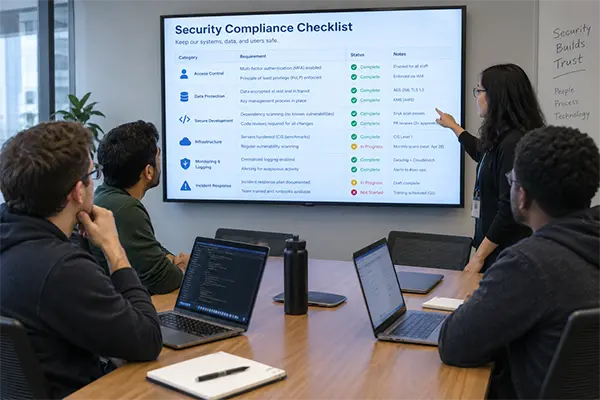
For legal and security teams, compliance is something on which the whole risk depends same as for software businesses. Processing this request requires more time that affects sales and procurement.
If you want more business for your company, take an interest in building security for software professionals and compliance against threat compositions. Every competitor generally builds authenticity for trust management for the long term.
To highlight your authentication, focus on securing a system and building unbreakable trust. Compliance is often the same trust that all competitors seek in system security parameters to be accurate and genuine.
This building software plays a role in system authentication and acquiring a certificate badge. Let’s understand its benefits in more detail:
The Edge Isn’t the Certificate
True compliance is trust-building, but saying it is not enough; the major setback is time.
The teams that acquire a potential buyer scale the software company with certificate proof or without verification. Certification is just a track that customers assume to be authentic. But listing reviews and ratings can take longer to satisfy.
Let’s understand with an example: if an enterprise has to evaluate two SaaS vendors, the first has responses with the latest security documentation and audit reports without customer assurance, and the other still collects the documents and fails to comply with buyers’ demands.
Similarly, the stage is where Memecast explains FedRAMP, which ensures standard security measures through monitoring, assurance, documentation, and involves cloud providers working with government officials to build trust.
As we say, trusting is like listening to a story, and the process begins when it starts.
Reuse Is What Makes It Work
FedRAMP is the clearest example of the mechanism because reuse is written into the program design.
The federal agency, under the US program est. in 2011, usually follows the benchmark provided by NIST SP 800-53, which provides the regulation to monitor in such a way that reuse of authorization is possible. Normally, agencies give third parties they can trust to scrutinize the system for vendors. This is a repetitive process in a cloud environment in which an agency responds quickly to negative reports.
While Mimecast instructs an authorization process with the help of agencies to inquire about the security parameters only once, that gives relief in sales to vendors and creates engagement fluency. This avoids repetition of assessments from the basics.
Creating a predefined security process that allows smoothness in the system builds trustworthiness and saves money and time consuming to restarting the process again.
Scarcity Is What Makes It a Moat
FedRAMP has a high number of authorized cloud services, around 500, which compares to federal agencies that work on SaaS products. That is responsible for scarcity because nobody easily meets the demands of the market. Focus on the shortlist, not the checkbox, as it is attained easily.
The ecosystem created by FedRAMP is visibly astonishing. Accomplishing that achievement is a difficult task; that’s the reason everybody lacks.
The moat is stronger with controls over integrated systems that comply with daily operations and organize annual audits, making it a market access barrier.
More difficult to assume and struggle to achieve, which all your competitors, including you, are way behind; that makes a moat.
Where Teams Get This Wrong
The problem is coping with the mistakes already occurred, and some of them are repeated; the first one is to focus on:
- Claiming a designation that doesn’t exist. Authenticating your credibility is essential; don’t try to fake or mislead the procurement team and give a reason to be removed from the list. “FedRAMP Compliant” or “FedRAMP Equivalent” does not create credibility. These types of marketing practices are not suitable for sustaining trust longer. This is also stated in FedRAMP’s Agency Authorization guidebook.
- Chasing the credential your buyers never asked for. This is most probably seen in moderate companies where the credentials are not required that much to specify their authenticity. To regulate the process, SOC 2 is more than enough to control your budget fluctuations.
- Treating authorization as the finish line. Compliance is the first step, not the whole thing. You must ensure system monitoring and regular assessment for smooth business operations, which can cost you more than usual.
- Letting sales find out last. Sales teams have an advantage when they know their job and act as they do. On-call certification is mentioned along with assurance during acquiring gives an advantage.
The Moat Is Currently Moving
The program is currently upgrading its system. You must ensure all points before budget allocation.
In 2026, FedRAMP introduced important updates regarding existing program Rev5 for new authorizations targeted till half of 2027. Including maximizing automation processes to be 20x faster.
This will lead to automation and its credibility being enhanced in the adaptation by several agencies; otherwise, there is a fallback and negative impact on authorization, and it keeps on decreasing.
Pay attention to all the details before fixing the budget. Authorization is the only way to maximize your reputation.
Final Analysis
For building trust compliances is the hard truth where no competitors are on the back foot.
If you are in the middle of acquiring an order, then the buyer should be convinced to an extent that your credibility is much higher than your competitor’s. If this does not happen, then you are wasting money on such things that the market doesn’t recognize as compatible.
Budget allocation should be the last decision, where you can estimate the orders that are pending or that are denied due to low authentication.
To build a secure system, it must be documented, reusable, and trustworthy to buy.
Frequently Asked Questions
Is SOC 2 or FedRAMP the better starting point?
Can we market ourselves as FedRAMP compliant while working toward authorization?
Ans. Absolutely Not. There is no term “FedRAMP Compliant,” and “FedRAMP Equivalent” doesn’t confirm its credibility. Using such claims decreases your authenticity for the buyer to trust.
How long does federal authorization actually take?
Ans. It can take almost one to three years for authorization through the common way; it must slow down as usual by introducing newer paths.
Does certification expire?
Ans. Probably not, but monthly assessment or monitoring system flexibility is needed to run the process frictionlessly and risk-free.
Related Posts
How to Protect Business Data From Unwanted Scrapers
Scrapers are a well-known problem for businesses; protecting private records, discouraging unwanted bulk copying, and preserving access are topics one…
Your Email is Data Too: Testing AI Tools That Work Without an Account
People who read about data recovery are most likely to think hard about the place where the files can go.…

UX Design Firm or Full Product Partner: Who Owns the Outcome?
The ownership argument between both kinds of suppliers never ends. The sentence costs nothing to say, but blindly trusting that…
What is BitLocker and How Does It Work?
A stolen laptop can expose far more than the device itself. Your documents, work files, photos, and personal information may…

Beyond the Checkout: 5 Best High-Risk Merchant Account Providers for Online Businesses
Even with polished checkouts, online stores can still have trouble getting secure, suitable payments. The process is more complex than…
The 8 Best Automated Accessibility Testing Tools for Websites
Great copy and sharp design don’t prove that your website is accessible. It’s things like colour contrast, missing alt text,…
Cybersecurity Training for Beginners: 4 Practical Options Compared
Starting in cybersecurity is confusing because most beginner options look similar on the surface. Some are compact awareness courses, some…
The Ultimate Guide to Electronic Signatures for Businesses 2026
Electronic signatures are making modern workflows more convenient and time-saving. This guide to electronic signatures will let you know how…
How Email Authentication Fits Into a Layered Cybersecurity Strategy
One convincing email can be sufficient to pose major problems regarding security for a business. An email that appears to…