


Initially, no. You can use breached-published data and asset inventory to embed your model security. The need for an analyst comes when you want a decision related to budget and implementation technicalities.
Cyber Risk Quantification for IT Teams: Turning Security Spend into Hard Numbers
Table of Contents
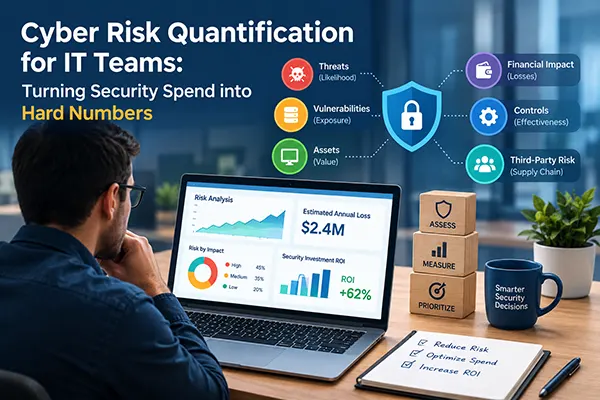
Security teams are receiving lots of alerts, which include report dashboards and vulnerability scores. The CFO asks the real question that comes up in meetings: “How does this risk exposure actually cost us?” which raises the need for cyber risk quantification.
If you can detect the threat, you have to understand its financial aspects of high risk and security-related losses that actually bother you, including penalties, legal issues, revenue slowdown, and recovery costs. Also, you are accountable for providing responses to IT and business security to minimize the effect.
In this session, you’ll learn the actual meaning of cyber risk quantification and that only matters.
Let’s dive into the financial security threat and take a tour to understand what number indicates.
Key Takeaway
- CRQ expresses risk as probable annual loss in dollars, not a severity label, which makes it comparable to every other business risk.
- Use open, documented data that you can defend. You face difficulties explaining the proprietary score to teams, auditors, or an insurer.
- A limited dataset from published breaches is good enough to start your risk assessment.
What Cyber Risk Quantification Actually Means
The simple way to understand CRQ is to use comparable numbers instead of hard terms with an estimated approach.
Drop saying “the vendor has a C+ score”; replace with “the vendor relationship costs $ 2.4M annual loss,” which quantifies the numbers and better situates the control spend of $180K, skipping the mental translation.
Example: Replace ”My database has high risk to ransomware” with “A ransomware attack on our system can affect estimated $5M to $10M losses with around 10% annually”
The method that most serious implementations use is Open FAIR; it uses a proprietary algorithm discarded. An auditor, insurer, or a board member can evaluate the numbers and make a decision to question it or not. While a black box has nothing to inspect further.
1) Why “High, Medium, Low” Stopped Convincing Anyone
Heat maps don’t work in real time and lack decision-making capability.
A high variable or inadequate findings that lack outcomes. First, a critical-severity flaw in a lab system which also faced by non-ITs. Second is a severity issue in payment processing systems. Both are visibly similar, and the IT person is aware that it is hard to distinguish patterns.
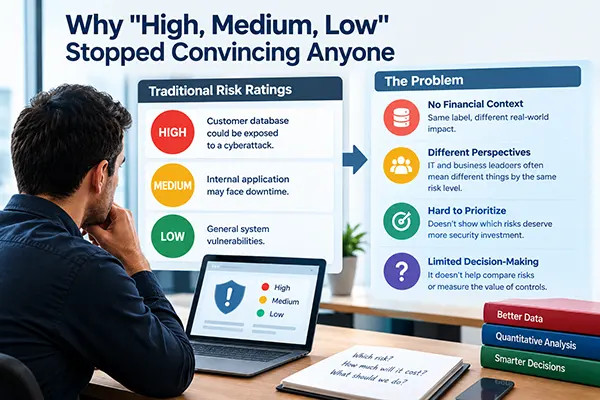
Risk in dollar values and heat symbols red-yellow-green ratings are compared simultaneously to find potential loss.
The numbers will not be a perfect valuation. It can be less or more. But more importantly, making assumptions helps us after compare.
In the US, all public entity all liable to disclose cybersecurity threat information along with their annual account of risk profile on Form 8-K within a limited time since Dec 2023. This is a Financial statement where you can’t uphold your own decisions with incidence happened.
2) The Three Inputs Behind Every Loss Estimate
Every quantified estimate, however sophisticated the tooling, reduces to three questions.
| Input | Actual Meaning | Origin of the evaluations |
|---|---|---|
| Frequency level loss | Rate of facing this type of threat to your organization | Combination of Industry data, threat intelligence, and incident history of your organization |
| Impact on magnitude | What cost occurred entirely — response, recovery, downtime, legal, churn, reputational | Published breach-cost research, past incidents, finance |
| Control effect | How much a specific investment moves either of the above | Modeling effects on situation and results |
Product of magnitude of occurrence and frequency distribution results in the loss covered. CFO analyzes the data included in the third row—$1.2M is dropped by exposing the sum of $400K spends.
Always work on ranges doesnt conclude decision into single figure. Instead of saying $3.4M, say somewhere between $2.3M and $5.2M to be more reliable for forecast data.
3) Real Numbers You Can Build From Today
Many assume the false thought that there is a lack of availability of internal data. But plenty of numbers are available in the public domain; fetching the data in real time is not practically feasible.
IBM’s 2026 Cost of a Data Breach Report estimates the global cost of a breach at $4.99 million, increasing by 12% annually. Breach frequency is 602 across several organizations. Savings are reported to be $1.93 million, obtained for security purpose on organisation through AI and automation.
Identifying a breach and recovery takes around 247 days— over many years, this impacts the system in AI enabled attack which cross the limit, and loss is most probably more than average. More dwell time can increase the cost of bearing. These data may make your model more exposed and undermine your own findings.
The figures may be used for your company model, as the total average loss differs from your own. Internal evidence can create impact referencing in published reports. It’s a defensible starting anchor; you adjust the size, sector, and data footprint, which eventually beats a color.
4) Where Third-Party Risk Breaks the Model
This part ruins the clean spreadsheet badly.
Did You Know?
IBM 2026, where 30 factors are considered and analyzed. It reported that a compromise of the supply chain and business partner elevates the global mean by over $ 227,250. The supply chain is the most crucial attack vector and ranked second with the longest breach cycle of 258 days in the dimension of attack variation.
Your risk is not bound to your alignment, but vendor risk also affects the system. If five vendors run together with the cloud provider, the risk is not individual; it’s a composite of all. Though models face five issues and recognize them all together.
Quantifying beats scoring most of the time; a security rating tells the situation of the vendor.
Quantifying helps you to identify the risk involved; this helps you to analyze what to do with the vendor in the future, either renew, stay connected, or walk away. This framework builds an environment where model breach effect the vendor management and their financial security. Instead, processing handles situations separately.
5) What CRQ Won’t Do for You
Limiting CRQ to an extent won’t help you in the long run. You have to secure the exposure of CRQ in your business, which is productive.
- It won’t manufacture certainty: This relies only on the assumption that no risk model gives correct figures. If anyone guarantees you an exact match it absolutely a false commitment.
- It’s only as good as your asset inventory: You cannot quantify exposure on systems you don’t know exist.
- It won’t replace technical assessment: Good asset inventory, cybersecurity governance, monitoring conditional figures, and testing the output where CRQ cannot cope with the model.
- It can be gamed. Assumptions drive outputs, and assumptions can be tuned toward whatever budget you want. Document them and let someone else review them.
This can give a defensive figure to control and make better decisions.
Conclusion
You can try to stay with vendors’ instructions, take small steps, evaluate the scenario into the most important aspects like ransomware attack, production system, data breach—build a boundary against all losses and breach to system set frequency and magnitude accordingly.
This is an initial working model that can adjust your budget meeting into dashboard representation. The aim is to discuss the vulnerability in exact detail, similar to other techniques follows the company ecosystem.
Frequently Asked Questions
Do I need a dedicated risk analyst to run CRQ?
How accurate are these estimates, honestly?
You can estimate the outcomes with it; don’t rely on its accuracy. This probably helps to rank your risk and testing control investment.
What’s the difference between a security rating and cyber risk quantification?
Estimating the security level from ratings and CRQ helps you to acknowledge losses annually with the assumption.
Will this help with cyber insurance renewals?
Yes, underwriters prefer financial modeling of exposure rather than queries resolve and documented are protected quickly than proprietary score.
Related Posts
How to Protect Business Data From Unwanted Scrapers
Scrapers are a well-known problem for businesses; protecting private records, discouraging unwanted bulk copying, and preserving access are topics one…
Your Email is Data Too: Testing AI Tools That Work Without an Account
People who read about data recovery are most likely to think hard about the place where the files can go.…

UX Design Firm or Full Product Partner: Who Owns the Outcome?
The ownership argument between both kinds of suppliers never ends. The sentence costs nothing to say, but blindly trusting that…
What is BitLocker and How Does It Work?
A stolen laptop can expose far more than the device itself. Your documents, work files, photos, and personal information may…

Beyond the Checkout: 5 Best High-Risk Merchant Account Providers for Online Businesses
Even with polished checkouts, online stores can still have trouble getting secure, suitable payments. The process is more complex than…

The 8 Best Automated Accessibility Testing Tools for Websites
Great copy and sharp design don’t prove that your website is accessible. It’s things like colour contrast, missing alt text,…

Cybersecurity Training for Beginners: 4 Practical Options Compared
Starting in cybersecurity is confusing because most beginner options look similar on the surface. Some are compact awareness courses, some…

The Ultimate Guide to Electronic Signatures for Businesses 2026
Electronic signatures are making modern workflows more convenient and time-saving. This guide to electronic signatures will let you know how…

How Email Authentication Fits Into a Layered Cybersecurity Strategy
One convincing email can be sufficient to pose major problems regarding security for a business. An email that appears to…