
UBA is the procedure of monitoring and assessing the user activity within an application.
What Is User Behavior Analytics (UBA)? Understanding User Behavior Through App Metrics
 Reviewed By Brijesh Kumar Singh
  Upasna Deewan
Updated on: Feb 26, 2026
Each tap, scroll, pause, and swipe within an app tells a story. However, this is the point: most users do not say what they are thinking. They do not complete feedback forms or clarify their reasons for departure. They just disappear. That is where User Behavior Analytics (UBA) fits in.
UBA monitors what users want rather than what they desire. And that is strong, because behavior does not lie. As a matter of fact, when companies base their actions on behavioral data, there is much more engagement and retention just because they no longer build on assumptions but build on reality.
Whether it is a person experimenting with an option, quitting in the middle of the session, or coming back every day, such patterns are indicators. And in 2026, the apps hat will rise quicker than those that are smart enough to read them.
Let’s deconstruct the workings of UBA and understand why it has become a necessity.
Key Takeaways
- UBA scrutinizes practical user behaviors to produce insights.
- It assists in enhancing engagement, retention, and application performance.
- Metrics like DAU, retention, and session length are important.
- UBA is also involved in fraud and security detection.
- The tools of modernity apply AI to improve behavior analysis.
What Is User Behavior Analytics and Why It Matters
User Behavior Analytics (UBA) refers to the act of gathering and analyzing user interaction with an application. Rather than trying to look at the numbers, such as downloads or page views alone, UBA further analyzes the user actions, interaction patterns, session flows, and engagement levels.
As an illustration, Download Telegram does not cease the user. UBA helps track: What are their initial features? The frequency of their revolutions. Where do they drop off? This is important as it assists because it improves user experience, increases retention, and maximizes functionality according to actual use.
Concisely, UBA provides answers to the most significant question: So what are users doing within your app?
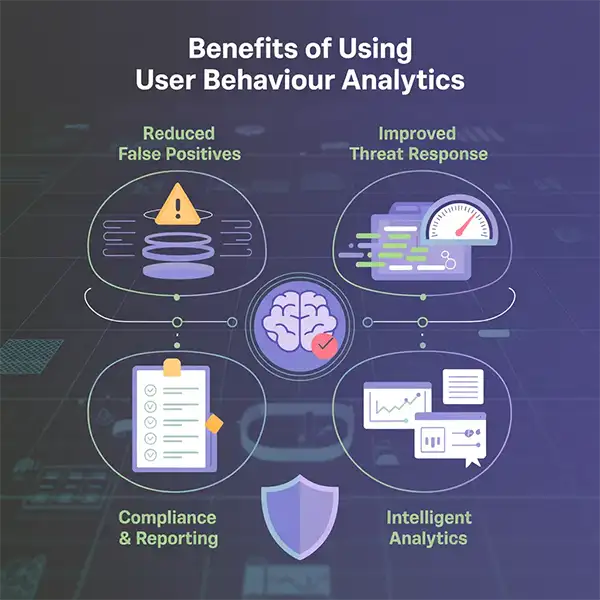
Furthermore, the infographic below depicts the benefits of using User Behavior Analytics. Have a look!
How UBA Works in Modern Applications
UBA operates with the help of data collection, processing, and analysis. It records user interactions in real-time and transforms them into impactful insights that teams can take action on.
Collecting User Activity Data Across Platforms
Modern apps can be used in different environments, such as mobile apps, web platforms, tablets, and desktops. UBA tools collect relevant data like clicks and taps, screen time, navigation paths, and location and device information. This provides a single perspective of user behavior at all touchpoints.
Analyzing Patterns, Sessions, and User Journeys
After data is gathered, it is analyzed to find patterns. This includes session duration, drop-off points, conversion paths, and repeated behaviors. For example, In case users abandon it after onboarding, onboarding should be enhanced. Provided that users come every day, then this is a strong indicator of engagement.
Plotting entire user journeys will help businesses understand exactly where users are having problems, and where they are not.
Key App Metrics Used in User Behavior Analytics
UBA uses certain metrics to gauge behavior.
- DAU and Monthly Active Users (MAU): These indicate the number of users who use your app on a regular basis.
- Retention Rate: Assess the number of returning users.
- Session Duration: Measures the duration of the users ‘ time in the app.
- Bounce Rate: Measures the rate of abandonment by the users of the app.
- Conversion Rate: Monitors the number of users performing required actions (sign-ups, purchases, etc)
These indicators give a vivid image of engagement, usability, and performance.
Role of UBA in Security and Threat Detection
UBA is not only a tool for enhancing user experience but also a potent security tool. Through behavior patterns, systems may identify aberrations, including unusual login locations, the abrupt increase in activity, and suspicious navigation patterns.
For example: Two countries are accessed by the same user in a few minutes → Possible violation.
Quick repetitions of access → Potential bot behavior.
UBA helps organizations detect threats early, prevent fraud, and strengthen system security. It provides a smart protection layer since it is not about credentials only, but rather behavior.
Tools and Technologies Used for User Behavior Analytics
Businesses use a variety of tools and technologies in order to implement UBA.
- Analytics Platforms: Monitor user activities, interactions, and performance indicators.
- Heatmap Tools: Highlight the most popular areas of clicks, scrolling, and interaction between users.
- Session Recording Tools: Record user interactions to learn in reality.
- AI-Powered Analytics: Identify trends and deviations automatically.
As an example, the patterns of usage on the WhatsApp Web version can be analyzed to show cross-platform mobility between mobile and desktop, the most commonly used features in the two, and where the users have friction. These lessons assist in the refinement of design and functionality.
PRO TIP
Following the paths of the users is not enough; follow the points at which they pause. Silences tend to be signs of confusion or areas of tension.
Conclusion
User Behavior Analytics transforms invisible data into visible data. It aids businesses to know not only what the users do but also why they do it. Since it enhances user experience for security threat detection, UBA has been an integral component of modern app development.
Guessing is no longer sufficient in a world where the attention of users is limited, as well as competition is high. The successful apps are the ones that listen, but not to what their users say, rather to what their actions tell them. As it is, all clicks are stories in the end.
Frequently Asked Questions
User Behavior Analytics (UMA) is defined as what?
What is the significance of UBA?
UBA helps enhance user experience, retention, and identification of security threats.
What is the data collected by UBA?
User activities, such as clicks, time spent, navigation history, and engagement.
Will UBA enhance the security of apps?
Yes, it identifies abnormal behavior that can be fraud or a violation.
What tools are applied to UBA?
Analytics, heatmap, recoding of sessions, and AI-based tools are applied to UBA.
Related Posts

8 Best AI Presentation Makers for Business-Ready Slides
Making a presentation doesn’t just mean designing slides. It’s about defining a clear structure, using defined logic, useful visuals, and…

Queue Management Software Troubleshooting Guide: 8 Common Faults and Fixes
The long wait times and ineffective management of customer queues can have a significant impact on customer satisfaction and business…

How to Use Similarweb Website Traffic Data for Competitor Research
Competitor research without traffic data is guesswork. You can guess who your rivals are, guess how big they are, guess…

Choosing the Right Hosting Model for Scalable Digital Platforms
The performance of digital business is directly related to website speed, uptime, and scalability. Slow page performance has a negative…

How Data-Driven Performance Tools Are Transforming Employee Recognition in Tech Companies
“People work for money but go the extra mile for recognition, praise, and rewards.” — Dale Carnegie (Writer & Teacher)…

Why Businesses Struggle to Collect Reliable Data from the Web
Almost every company that depends on data runs into the same problem: although they can find the data they need,…

Why Financial Data Recovery Matters for Businesses
Financial data supports every part of a business, directly affecting cash flow, payroll, tax reports, audits, customer billing, and daily…

CMMC Compliance Is Coming for Manufacturers. Here Is What You Need to Do
“Cybersecurity is much more than a matter of IT.” — Stephane Nappo (Cybersecurity Professional) For manufacturers working within the defense…

How Data-Based Tools Influence Learning Performance
Learning has transformed in the modern age with the integration of new technologies to help students and professionals prosper in…