
Yes, especially when it’s enterprise-grade and properly tested. In many cases, it isalready proven itself in real production environments.
Why You Should Consider Buying Refurbished IT Data Center Hardware
 Mahima Dave
Updated on: Dec 16, 2025
Table of Contents
- Understanding Refurbished IT Data Center Hardware
- Key Benefits of Buying Refurbished Data Center Hardware
- Common Types of Refurbished Data Center Hardware
- Reliability and Performance Considerations in Refurbished Hardware
- Data Security and Compliance Factors
- When Refurbished Hardware Makes Sense for Modern Enterprises
- Final Take
- Frequently Asked Questions
Are you aware of the fact that more enterprises are now rethinking how they build and upgrade their data centers? They are now trusting Refurbished equipment, which allows them to balance performance, budget, and sustainability goals.
And this is not just some niche trend;hardware accounts for 46% of the total refurbished data center market share, with servers, networking gear, and storage systems leading the pack. (Source: Market.us)
Curious to know more? In this post, we will explore what refurbished hardware really means, why it’s gaining traction, and how it can deliver enterprise-grade results without the premium price tag.
Key Takeaways
- Refurbished doesn’t necessarily mean outdated; it is usually tested, certified, and ready to work efficiently.
- Enterprises often replace hardware on schedule, not because it’s failing.
- Refurbished gear can deliver the same performance at significantly lower cost.
- Faster availability makes it ideal for expansions, backups, and urgent deployments.
- With the right vendor, warranties and support are part of the deal; not an afterthought.
Understanding Refurbished IT Data Center Hardware
As the name explains, refurbished IT data center hardware refers to enterprise-grade equipment that has previously been used, returned, or decommissioned and then restored to full working conditions.
Now, don’t judge it by the fact that it was “used” before because refurbished equipment is validated for performance and reliability, often backed by warranties and support. So, these prove to be a cheap yet dependable infrastructure. Services like ETB ensure that you get a reliable refurbished product.
DO YOU KNOW?
Many “refurbished” servers were barely used before being decommissioned.
Key Benefits of Buying Refurbished Data Center Hardware
Obviously, cost reduction is one of the most talked about benefits of refurbished hardware, but this is not it. There are many other benefits that come with buying reconditioned systems:
Cost Savings and Budget Optimization
Imagine you have two options:
- Buying new hardware for premium cost and compromising on other resources due to a certain budget.
- Buying refurbished hardware for cheaper (but the functionality remains the same) and invest on other things.
Most people would think that 2 is the best choice here, and rightly so. This equipment cuts costs significantly, and the savings can be directed towards software, cloud integration, security initiatives, or future upgrades.
Enterprise-Grade Performance at Lower Cost
Refurbished hardware does ot equates to poor efficiency. Most of those originate from large enterprises that refresh equipment on fixed cycles so that the buyers can gain access to high performance serves, networking gear, and storage systems that still meet demanding workloads.
Faster Procurement and Deployment
Generally, new hardware comes with long manufacturing and delivery timelines that can delay the workflows. Whereas refurbished equipment is usually available immediately, speeding up the procurement and deployment.
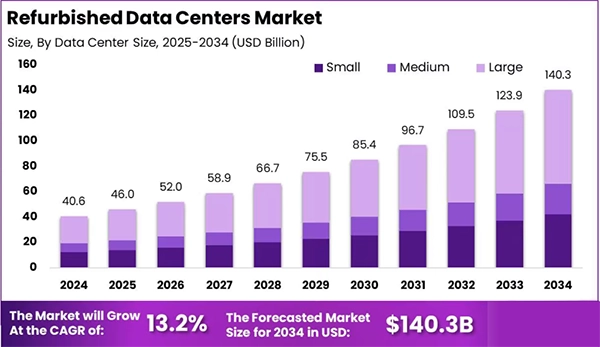
Since it provides so many benefits, the refurbished data centers market is on the rise and is expected to reach $140.3 billion by 2034 from $40.6 billion in 2025, growing at a CAGR of 13.2%.
Common Types of Refurbished Data Center Hardware
A wide variety of data centres is commonly available in refurbished form. The most commonly seen are:
- Servers and Compute Hardware: Servers are one of the most popular choices in the refurbished market. These include rack servers, blade servers, and standalone compute units that support virtualization, databases, and application workloads.
- Network Switches and Routers: Devices like switches, routers, and firewalls are built to last and are mostly capable of supporting modern network architectures even after years of service, and hence are frequently refurbished.
- Storage Systems and Components: Storage solutions like SAN, NAS, and individual drives are another popularly refurbished option. These offer scalable data capacity, that too at reduced costs.
Reliability and Performance Considerations in Refurbished Hardware
Refurbished hardware can be really helpful for some organizations, but for others, it may raise reliability and performance concerns. Since these devices were already “used” in the past, it becomes difficult to find out if these will work as efficiently as the new ones.
So, to avoid such issues, always purchase from reputable sellers that run these through extensive testing and certification processes before putting them out for sale in the market. It is always best to purchase from sellers who provide warranties for their services. Also, pay attention and look for any kind of physical damage.
Data Security and Compliance Factors
Another critical consideration when buying refurbished hardware is data security. Most reputable vendors follow a strict data sanitization standard that makes sure all the previous data is completely erased. Certifications and documented processes help meet compliance related to data protection and privacy.
Additionally, organizations should also verify firmware integrity, update security patches, and follow internal compliance protocols to maintain a secure infrastructure environment.
When Refurbished Hardware Makes Sense for Modern Enterprises
Refurbished hardware has various benefits, but it is not the best option for everyone. These are especially well-suited for:
- Test environments
- Disaster recovery setups
- Branch offices
- Capacity expansion projects
- Businesses seeking to reduce capital expenditure while maintaining enterprise-level performance
For modern enterprises trying to balance cost and operational reliability, refurbished hardware can be an excellent choice.
Final Take
Buying refurbished data center hardware is a smart choice for most businesses. It not only cuts costs but is also a more sustainable alternative. Such equipment gives you proven access, enterprise-grade systems that still have plenty of lifetime left, without draining your budget.
In short, it is like a practical middle ground for modern enterprises that provides reliable performance, faster accessibility, and financial breathing.
Frequently Asked Questions
Is refurbished hardware reliable enough for business use?
Will refurbished hardware become obsolete faster?
Not necessarily. Obsolescence depends more on workload needs and software compatibility than on whether the hardware is new or refurbished.
Do refurbished products come with warranties?
Not all, but some reputable vendors offer warranties and support options, sometimes comparable to new hardware coverage.
What is the biggest mistake companies make when buying refurbished equipment?
The biggest mistake often made by companies is focusing on price instead of vendor credibility, testing standards, and support terms.
Related Posts

8 Best AI Presentation Makers for Business-Ready Slides
Making a presentation doesn’t just mean designing slides. It’s about defining a clear structure, using defined logic, useful visuals, and…

Queue Management Software Troubleshooting Guide: 8 Common Faults and Fixes
The long wait times and ineffective management of customer queues can have a significant impact on customer satisfaction and business…

How to Use Similarweb Website Traffic Data for Competitor Research
Competitor research without traffic data is guesswork. You can guess who your rivals are, guess how big they are, guess…
Choosing the Right Hosting Model for Scalable Digital Platforms
The performance of digital business is directly related to website speed, uptime, and scalability. Slow page performance has a negative…

How Data-Driven Performance Tools Are Transforming Employee Recognition in Tech Companies
“People work for money but go the extra mile for recognition, praise, and rewards.” — Dale Carnegie (Writer & Teacher)…

Why Businesses Struggle to Collect Reliable Data from the Web
Almost every company that depends on data runs into the same problem: although they can find the data they need,…

Why Financial Data Recovery Matters for Businesses
Financial data supports every part of a business, directly affecting cash flow, payroll, tax reports, audits, customer billing, and daily…

CMMC Compliance Is Coming for Manufacturers. Here Is What You Need to Do
“Cybersecurity is much more than a matter of IT.” — Stephane Nappo (Cybersecurity Professional) For manufacturers working within the defense…

How Data-Based Tools Influence Learning Performance
Learning has transformed in the modern age with the integration of new technologies to help students and professionals prosper in…