
Learning analytics uses student data to find trends, inform instructional decisions, and enhance personalized learning opportunities.
Data-Driven Education: Using Learning Analytics in Modern Educational Software Development
 Mahima Dave
Updated on: Sep 10, 2025
Table of Contents
- What learning analytics actually is
- How modern educational software uses those signals
- What it can do
- Evidence and limits: magic? – or careful engineering?
- Ethics, privacy, and the student in the loop
- Design principles for developers who care
- The future: smarter systems, not surveillance
- Final thought
- Frequently Asked Questions

KEY TAKEAWAYS
- Learning analytics improves student performance and retention in higher education.
- Seventy-two percent of U.S. colleges are investing in learning analytics.
- Data helps educators personalize instruction by analyzing behaviors and outcomes.
- Educational software integrates analytics to support effective learning design.
Data has emerged as a potent means of facilitating the future of learning in the last few years. In fact, EDUCAUSE reports that 72% of U.S. higher education institutions are investing in learning analytics for the purpose of improving students’ performance and retention.
Learning analytics tend to be most commonly implemented with digital platforms and software. Therefore, educators can examine patterns, behaviors, and outcomes through data access for personalized instruction. Learning analytics is a critical component of features for educational software development.
Let’s examine below how learning analytics informs content and software design, supports pedagogy, and champions students’ learning and success.
What learning analytics actually is
At its core, learning analytics involves collecting, analyzing, interpreting, and sharing learner data to improve both teaching and learning experiences. It is not simply administrator dashboards, but an interdisciplinary practice that is a product of education research, data science, and software engineering.
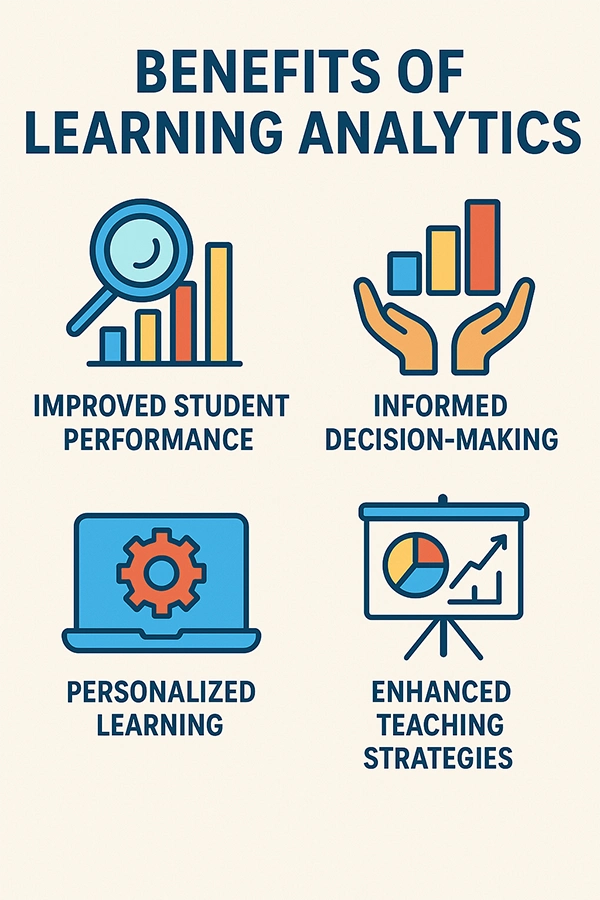
Learning analytics, when effective, is a way of connecting theory and practice: pedagogical questions inform measurement rather than the reverse. The use of analytics as an evidence-generating tool in teaching is equally emphasized within policy and research contexts. Below, you can see the benefits of learning analytics.
How modern educational software uses those signals
Learning products in the modern world combine learning management systems, quizzes, video interactions, and third-party applications together to form stratified maps of activity.
Adaptive platforms build on that data in real-time to adjust the path a student follows; predictive models identify students who are likely to drop out. Instructors can intervene; aggregated analytics can show which modules are consistently confusing students and require a redesign.
Such capabilities are becoming common in the commercial and open, and the analytics stack that makes a course personalized also reveals structural biases when applied at scale.
What it can do
- Tailor content and pacing to each learner.
- Predict and prevent dropout through early alerts.
- Reveal hidden patterns teachers can’t see in a crowded classroom.
Evidence and limits: magic? – or careful engineering?
It promotes positive research suggesting that predictive and adaptive analytics can boost retention and performance through timely, pedagogically meaningful interventions. However, the literature is also aware of the dangers of overprinting: models are fragile in new settings, correlation does not mean causality, and too high expectations can cause vendors to promise more than they can deliver.
Recent commentaries encourage institutions to integrate analytics with cautious analysis and human judgment as opposed to delegating decisions to black box algorithms. In short, analytics can enhance effective teaching but never replace it.
Ethics, privacy, and the student in the loop
All this rich information begs actual ethical questions. Who owns learning footprints, how long they are stored, and which models identify students as at risk? Student records in most countries are safeguarded by legal provisions such as FERPA, and schools will have to face the issue of consent, data reduction, and confidential storage.
In addition to legality, designers have to contend with fairness: predictive systems can recreate biases in historical data, punishing students of under-resourced backgrounds unless the team is designed to avoid it.
Design principles for developers who care
When you are developing learning software, begin with a question, not the data. Translate pedagogical goals into measurable metrics and design analytics as a teacher/learner aid, not as an opaque decision-maker.
Consider interoperability (in such a way that data passes safely between systems), transparency (in such a way that stakeholders can see how decisions are made), and iterative validation (test models across cohorts and revise). Integrate analytics with easy teacher controls: predictive flags should include evidence-based actions and a simple way to record performance.
The future: smarter systems, not surveillance
Picture the classroom in five years: seamless, privacy-respecting insights that help a teacher catch a student’s confusion before it calcifies into failure; curricula that evolve as analytics surface unanticipated learning pathways; and policymakers making data-informed decisions that close gaps rather than widen them. Reaching that future demands not just better models, but also interdisciplinary collaboration, solid ethics, and earned public trust.
Final thought
Learning analytics gives educational software an uncanny advantage: the ability to listen. When developers and educators tune their instruments toward humane goals, data becomes a translator between intention and outcome. A calm, consistent approach helps learners reach their
Frequently Asked Questions
What is learning analytics in education?
Why are institutions investing in learning analytics?
Colleges use learning analytics to increase student performance, enhance student retention, and provide better educational support in a more personalized format.
How can learning analytics improve the experience of students?
Students will utilize customized paths, timely feedback, and improved chances of success through an analytics-driven learning process.
Related Posts
8 Best AI Presentation Makers for Business-Ready Slides
Making a presentation doesn’t just mean designing slides. It’s about defining a clear structure, using defined logic, useful visuals, and…
Queue Management Software Troubleshooting Guide: 8 Common Faults and Fixes
The long wait times and ineffective management of customer queues can have a significant impact on customer satisfaction and business…
How to Use Similarweb Website Traffic Data for Competitor Research
Competitor research without traffic data is guesswork. You can guess who your rivals are, guess how big they are, guess…

Choosing the Right Hosting Model for Scalable Digital Platforms
The performance of digital business is directly related to website speed, uptime, and scalability. Slow page performance has a negative…
How Data-Driven Performance Tools Are Transforming Employee Recognition in Tech Companies
“People work for money but go the extra mile for recognition, praise, and rewards.” — Dale Carnegie (Writer & Teacher)…
Why Businesses Struggle to Collect Reliable Data from the Web
Almost every company that depends on data runs into the same problem: although they can find the data they need,…
Why Financial Data Recovery Matters for Businesses
Financial data supports every part of a business, directly affecting cash flow, payroll, tax reports, audits, customer billing, and daily…

CMMC Compliance Is Coming for Manufacturers. Here Is What You Need to Do
“Cybersecurity is much more than a matter of IT.” — Stephane Nappo (Cybersecurity Professional) For manufacturers working within the defense…
How Data-Based Tools Influence Learning Performance
Learning has transformed in the modern age with the integration of new technologies to help students and professionals prosper in…