Running a business today means dealing with terabytes of customer data. It keeps flowing through CRMs, cloud apps, employee devices, and third-party vendors. Yet, you may not know where the sensitive information actually resides.
And this is why data breaches are one of the biggest concerns for organizations today. According to the IBM Cost of a Data Breach Report 2025, the average cost of a data breach was $4.44 million. This shows how poor data protection strategies can lead to massive financial loss.
And this is exactly why having data privacy management software, such as ServiceCore management software, becomes necessary, not just as a compliance tool but as a business-critical system for protecting sensitive data at scale.
Key Takeaways
Data privacy management software offers businesses visibility and control over sensitive data across systems.
It plays an important role in reducing breach risks and ensuring regulatory compliance.
Automation replaces manual processes, making privacy management faster, more accurate, and scalable.
Strong data protection practices directly contribute to customer trust and brand credibility.
Why Data Privacy Management Is Critical for Modern Businesses
The businesses today have ceased to be merely for users, but rather data ecosystems. Organizations continually gather, process, and store huge volumes of personal and operational data, whether it be customer onboarding systems, analytics platforms, and so on.
Nonetheless, this online proliferation has created a dangerous disconnect: companies do not necessarily know what data they process, where it is, or who can access it. This lack of visibility is one of the biggest contributors to data breaches today.
This complexity is well described in industries such as airline software development. Airlines run passenger identities, payment information, travel records, and biometrics information over international networks. One vulnerability within such interconnected systems may cause massive exposure.
More to the point, the world is becoming increasingly restrictive in terms of regulations. Such laws as GDPR, DPDP, and CCPA require organizations to be accountable not only following a breach but also protecting it, and respond swiftly in the event that risks arise.
Unless privacy is managed in a systematic way, companies will face the risk of:
Regulatory penalties
Reduction of customer confidence
Operational disruption
Long-term reputational damage
In summary, data privacy is no longer an IT concern, but rather a priority of the boardroom.
DO YOU KNOW? Data privacy management software helps businesses navigate a landscape where 79.3% of the world’s population is now covered by some form of national data privacy law, such as GDPR or CCPA.
What Is Data Privacy Management Software and How It Works
Centralized data privacy management software is a centralized platform that assists organizations in discovering, classifying, monitoring, and protecting sensitive data across systems and ensures compliance with privacy regulations. Fundamentally, this software substitutes the manual and fragmented processes with automated intelligence.
Data Discovery: The software goes through structured and unstructured environments: databases, cloud storage, emails, SaaS tools, etc., to reveal where sensitive data is stored. This encompasses personal identifiable information (PII), financial data, and proprietary business data.
Data Classification: After it has been discovered, the data is classified according to the sensitivity level and the level of risk. As an illustration, customer payment information could be categorized as high-risk, and internal documents could be low-risk. This categorization enables organizations to focus on protection activities.
Continuous Monitoring: Privacy tools are offered instead of a single-time audit, offering real-time monitoring. They monitor data access, sharing, or editing, indicating suspicious activity such as illegal downloading or transfer of data.
Automation of Policy Enforcement and Compliance: Compliance workflows are automated with modern tools. Some of the policies they implement are data retention limits, consent tracking, and across control. In case a regulation states that data should be deleted after a specific time frame, the system will make sure that it is automatically done.
Essentially, these platforms serve as a control tower of data privacy, and they provide businesses with visibility, control, and actionable insights.
Key Features to Look for in Data Privacy Management Software
In picking a solution, businesses must not consider any generic features but look at capabilities that directly deal with risks in the real world; your client data is a top priority after all, and not all the tools are capable of providing such a high level of protection.
Unified Data Visibility: The robust platform must offer a single dashboard where all sensitive information is stored, both on premises systems, cloud infrastructures, and third-party integrations.
AI-Powered Risk Detection: The more advanced tools apply machine learning to detect anomalies, including unusual access patterns or possibly insider threats. This is a proactive detection that is vital in averting breaches even before they take place.
Automated Compliance Management: Seek built-in structures of international regulations. The software must be able to create audit trails, compliance reports, and risk assessments without human intervention.
Access Governance: Granular access control will make sure that only authorized users can access and/or edit sensitive information. Zero-trust architecture and role-based access are increasingly becoming a standard requirement.
Incident Response Integration: The security systems should also be integrated with the platform to facilitate quick response in case of a breacj0minimizing the time to detect and contain the breach.
Vendor Risk Management: Since there has been an increase in third-party breaches, the tools should also assess and track vendor access and compliance posture.
Benefits of Implementing Data Privacy Solutions in Organizations
Data privacy solutions bring a list of tangible and measurable benefits. Firstly, it minimized the risk of breach by removing the blind spots in data handling. Organizations can identify and respond rapidly to threats by monitoring them in real-time and providing automated alerts.
Secondly, it enhances efficiency in operations. The process of manual audit, compliance reporting, and data mapping is time-consuming and prone to errors. The automation liberates the teams to concentrate on strategic activities, as opposed to repetitive compliance tasks.
Third, it boosts customer trust. With privacy being a major concern among the population in a market, a business with good data protection practices will have a competitive edge. Customers will have higher chances of interaction with the brands that value their data safety.
Lastly, it decreases the financial impact. Given that breaches may cost millions, even a small decrease in risk may result in huge savings.
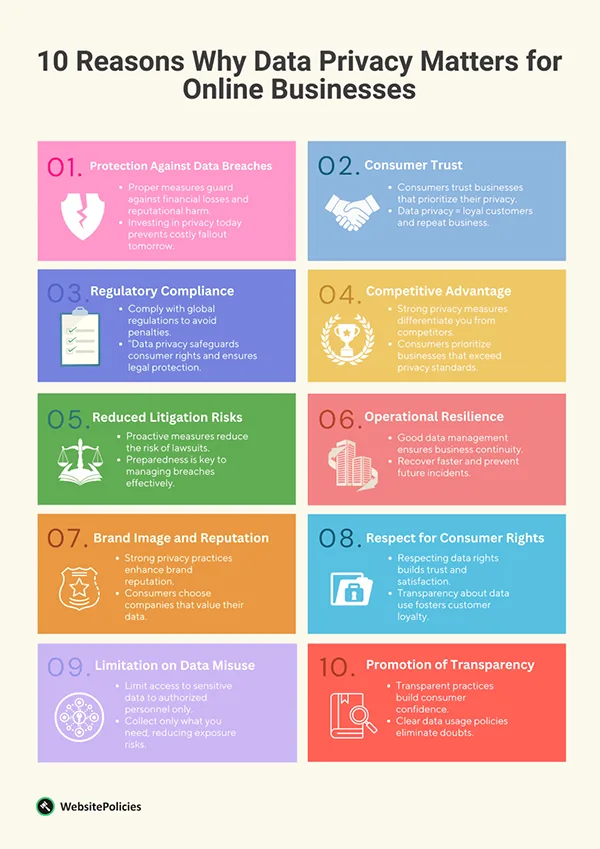
INTRIGUING INSIGHTS The infographic below shows 10 reasons why data privacy matters for online businesses. Have a look!
Common Challenges Businesses Face Without Privacy Tools
Companies that do not have a specific privacy management tool usually work in a reactive way.
Data sprawl is one of the most problematic issues; sensitive data is distributed among various systems without any clear ownership. It complicates finding or even locating important information.
Compliance fatigue is another problem. It is almost impossible to keep up with the changing regulations manually, and as a result, loopholes exist, and regulators can take advantage of them.
Slow detection of breaches is also a challenge to businesses. It is reported that in some cases, it may take months to detect and control breaches, and this amplifies the damage and recovery expenses.
Also, third-party risks are frequently ignored. Many of the breaches are caused by the vendors, but the companies have no idea how their data is being processed by their vendors.
Future Trends in Data Privacy and Security Technologies
The recent technological revolution and growing regulatory demands are shaping the future of data privacy. The incorporation of AI tools by businesses creates new vulnerabilities, which makes the issue of governance and access control more critical than ever.
The other major trend is privacy by design, of integrating protection of data when designing systems as supposed to seeing it as an add-on. This is also changing towards real-time compliance, where organizations are continuously monitoring and changing their practices rather than depending on periodic audits.
Lastly, decentralized data designs and zero-trust security frameworks are becoming more popular. These strategies reduce risk; fewer people have access, and fewer people are dependent on a centralized data storage.
Frequently Asked Questions
Do small businesses really need privacy management software?
Yes, and often more than large enterprises. Smaller businesses usually don’t have dedicated security teams, which makes them easier targets.
Is data privacy software only for compliance purposes?
Not at all. While compliance is a big part of it, the real value lies in preventing breaches, gaining visibility into your data, and building customer trust.
Can these tools completely prevent data breaches?
No tool is 100% secure. However, they significantly reduce risks by identifying vulnerabilities early, controlling access, and enabling faster response when something goes wrong.
What kind of data can this software protect?
It can protect a wide range of data, including customer information, employee records, financial data, intellectual property, and even data shared with third-party vendors.

 Reviewed By Brijesh Kumar Singh
  Saipansab Nadaf