
It refers to analytics systems designed for the unique workflows and reporting needs of specific industries.
Industry-Specific Data Analytics: Solving Competitive Business Data Challenges
 Reviewed By Brijesh Kumar Singh
  Mahima Dave
Updated on: Apr 01, 2026
Table of Contents
- Why Generic Analytics Often Fails Complex Business Needs
- What Makes Industry-Specific Data Analytics Different
- Common Complex Data Problems Across Industries
- How Tailored Analytics Improves Data Accuracy and Decision-Making
- Key Considerations for Smarter Data Problem-Solving
- H2: Conclusion
- Frequently Asked Questions
The volume of data gathered by a business is larger than ever before, but many customers have difficulty turning this data into meaningful business intelligence. It’s not always a volume of data issue; it’s an industry-specific operational need that isn’t covered by generic analytics systems. Today, organizations are turning to specialized analytics solutions to gain an efficiency boost, make better forecasts, and make better strategic decisions, according to Deloitte.
Compliance requirements, types of data generated, and even the way industries operate differ. Different industries have different compliance standards, types of data they are collecting, and very different ways of working. As a result, companies are shifting towards analytics solutions that are tailored to their processes, instead of using a reporting platform that fits all business types.
Key Takeaways
- Generic analytics platforms often struggle with industry-specific requirements.
- Specialized analytics improves reporting accuracy and operational visibility.
- Fragmented data creates major business intelligence challenges.
- Security and compliance are critical in data-heavy industries.
- Tailored analytics supports smarter and faster decision-making.
Why Generic Analytics Often Fails Complex Business Needs
The majority of general analytics platforms are aimed at a number of different sectors, a good idea in theory, but can be limiting in practice. Simple dashboards and general reporting figures typically aren’t enough for businesses that are complex operations.
For a healthcare organization, tracking patient outcomes, reporting on appointment efficiency, and generating regulatory audit trails may be essential. The value of a functional medicine EHR system lies in analytics that comprehend clinical workflows, not just typical business metrics.
This problem is common among companies that have other departments or systems that are not connected, or when complex reporting structures are in place. Often, these environments are not fully understood by generic tools, resulting in incomplete understanding and delayed decision-making.
Poorly aligned analytics is not intended to streamline processes, but can lead to confusion of reporting and a lack of visibility between teams.
What Makes Industry-Specific Data Analytics Different
Specialized analytics platforms are built to focus on the facts of a specific industry. These systems are designed to work around the way businesses operate instead of the software being adapted to the business. The distinction is particularly relevant in industries where adherence to regulations is paramount, operational interdependencies are significant, or real-time data flows are substantial.
Industry-focused analytics solutions usually include:
- Narrative models designed for sector-specific processes
- Increased integration with operational software
- Better forecasting due to industry trends
- Selecting monitoring and documentation that is complex-focused
- More transparency of performance bottlenecks
These systems are more than visualization systems. They can assist businesses in comprehending the meaning behind the figures, frequently the place where true operational value is generated.
Common Complex Data Problems Across Industries
There are some data issues that seem to crop up in most organizations these days, but are specific to each industry.
Fragmented Data Across Multiple Systems
Data fragmentation is one of the major problems that businesses encounter. Many times, information gets shared in different accounting systems, CRM software, inventory systems, cloud applications, and operational software.
For instance, in a construction environment, budgeting information could be available in a different system than scheduling or procurement. Gaps can be overcome by using construction wip software, which integrates operational and financial reporting into one.
Poor Data Quality and Inconsistent Formats
Even so-called advanced analytics systems fail to operate effectively when the underlying data isn’t consistent. Some typical challenges businesses face are duplicate entries, missing records, outdated information, conflicting reporting formats, and manual input errors.
These issues tend to occur quietly over time, across the various departments, until the reports are inaccurate, and operational forecasting begins to be in error. Validation rules are typically built into the industry-specific analytics platform to ensure consistency, and workflows are standardized as well, which helps reduce manual validation efforts.
With improved data quality, the accuracy of forecasts, operational planning, and reliability of reporting improves.
Security, Compliance, and Access Control Risks
Data security is no longer just an IT issue. It has become an operational issue for the entire business, particularly in companies that have medical, financial, or legal data.
Today’s organizations need to comply with protection standards while maintaining accessibility. Inconsistent permissions, unsecured integrations, or weak access controls can put businesses at risk of cybersecurity issues and regulatory fines.
Specialized analytics systems can offer:
- Role-based access controls
- Industry-focused compliance tracking
- Ensure there are activity monitoring and audit logs in place
- Stronger encryption standards
These features enable businesses to stay visible and keep information secure from unauthorized access.
How Tailored Analytics Improves Data Accuracy and Decision-Making
Where analytical systems harmonize with the work that needs to be done, decision-making quickens and becomes much more accurate. Rather than dealing with generic dashboards, companies will receive insights directly related to their day-to-day actions. Treatment efficiency could be analyzed by the healthcare industry, logistics can monitor delivery performance an deconstruction companies can monitor profitability in real-time.
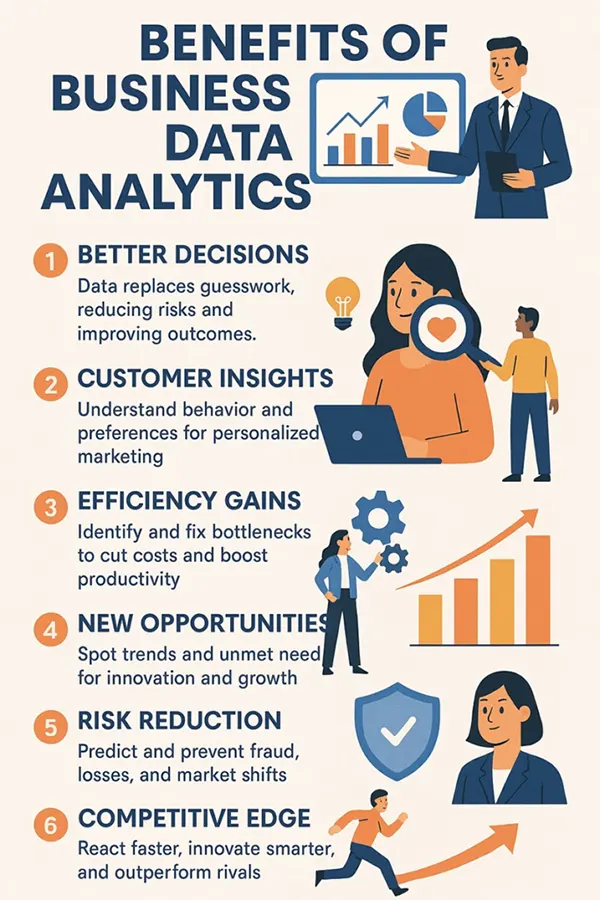
Benefits of tailored analytics include faster reporting processes, improved forecasting accuracy, better operational visibility, more effective resource planning, and stronger compliance monitoring.
Apart from this, the greatest advantage is clarity. Teams have less time to decipher random reports and more time to act on valuable information.
The infographic below further explains the benefits of business data analytics. Have a look!
Key Considerations for Smarter Data Problem-Solving
There are more factors to consider than just picking software with advanced features. These businesses need to access the system to see how well it will meet the requirements for operation and growth.
Some of the key factors may be:
- Ensuring that the new system can be integrated with existing ones
- Industry-specific reporting needs
- Security and compliance requirements
- Data governance capabilities
- The ability to expand and grow over time
It is also important for an organization to look for an analytics platform that does not increase the manual reporting load and complexity on the organization. The best analytics practices are typically the ones that make decision-making easy rather than difficult.
INTERESTING FACT
The construction, healthcare, and aviation industries were among the earliest sectors to adopt specialized analytics systems because even small reporting errors in those fields could lead to major financial losses, safety risks, or compliance violations.
H2: Conclusion
In today’s complex business landscape, industry-specific analytics has emerged as a key enabler in addressing emerging data problems. While usual platforms offer generic reporting, they are not necessarily designed to meet the specific workflows and compliance needs.
Customized analytics solutions enable companies to integrate disjointed data, boost reporting precision, enhance security, and make quicker strategic choices. Organizations that leverage analytics solutions that are industry-specific and solution-specific are more likely to enhance their efficiency, mitigate operational risk, and remain competitive in the modern data-driven environment.
Frequently Asked Questions
What is industry-specific data analytics?
Why do generic analytics platforms fail some businesses?
They often lack customization, compliance support, and industry-focused reporting features.
What industries benefit from specialized analytics?
Healthcare, construction, finance, logistics, and manufacturing commonly use tailored analytics solutions.
How does tailored analytics improve decision-making?
It provides more accurate and relevant insights based on industry-specific operations and metrics.
Related Posts

8 Best AI Presentation Makers for Business-Ready Slides
Making a presentation doesn’t just mean designing slides. It’s about defining a clear structure, using defined logic, useful visuals, and…

Queue Management Software Troubleshooting Guide: 8 Common Faults and Fixes
The long wait times and ineffective management of customer queues can have a significant impact on customer satisfaction and business…
How to Use Similarweb Website Traffic Data for Competitor Research
Competitor research without traffic data is guesswork. You can guess who your rivals are, guess how big they are, guess…
Choosing the Right Hosting Model for Scalable Digital Platforms
The performance of digital business is directly related to website speed, uptime, and scalability. Slow page performance has a negative…

How Data-Driven Performance Tools Are Transforming Employee Recognition in Tech Companies
“People work for money but go the extra mile for recognition, praise, and rewards.” — Dale Carnegie (Writer & Teacher)…

Why Businesses Struggle to Collect Reliable Data from the Web
Almost every company that depends on data runs into the same problem: although they can find the data they need,…
Why Financial Data Recovery Matters for Businesses
Financial data supports every part of a business, directly affecting cash flow, payroll, tax reports, audits, customer billing, and daily…

CMMC Compliance Is Coming for Manufacturers. Here Is What You Need to Do
“Cybersecurity is much more than a matter of IT.” — Stephane Nappo (Cybersecurity Professional) For manufacturers working within the defense…

How Data-Based Tools Influence Learning Performance
Learning has transformed in the modern age with the integration of new technologies to help students and professionals prosper in…