
In most cases the data you already have for prospecting covers it. A dedicated tool earns its place once someone is actually acting on the signals weekly and the manual review becomes the bottleneck.
From Data Points to Decisions: Turning Sales Intelligence Into Competitor Research
 Written by Saipansab Nadaf
Table of Contents
- What Sales Intelligence Data Actually Shows You
- From Data Points to Decisions
- Where the Appetite for This Spreads
- Why Finance Teams Ask for the Business Case
- Competitors Are Showing Up Somewhere Else Too
- The Same Decision Shows up in Link Building Too
- The Habit That Actually Pays for the Subscription
- Frequently Asked Questions
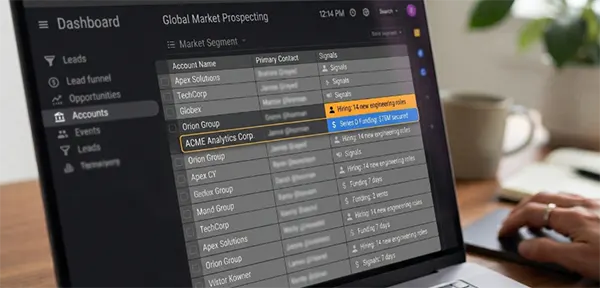
Sales intelligence tools get sold as a prospecting shortcut: more contacts, more intent signals, more pipeline to work. That’s the pitch, and it’s not actually where most of that subscription earns its cost.
The same contact records, hiring signals, and tech-stack data a sales team pulls for outreach double as a live read on what competitors are doing right now. Most teams never turn around and look at it that way.
This is what that second use looks like, and what else tends to get pulled into the decision once the habit of reading signals, rather than just collecting them, actually starts.
Key Takeaways
- Most tools like LinkedIn Sales Navigator were never built to give information to the competitor; however, these tools that were built for prospecting now also give access to see what your competitors are doing.
- There are mainly 4 types of signals that matter when collecting intelligence. These include hiring, tech stack, funding, and messaging changes.
- Most companies keep spending on buying more software tools without assigning a person to actually read all of this data and make a decision. This is actually where most companies lose their budget, and it is not worth it.
- The same buy-vs-DIY decision shows up again in finance automation, GEO visibility, and link building.
What Sales Intelligence Data Actually Shows You
There are a lot of different metrics through which you can get to know what your competitor is actually investing in, and that way you get to know more about their company and how they handle things.
| Signal | What It Actually Reveals About a Competitor |
|---|---|
| New job postings | Where they’re investing headcount next |
| Tech-stack changes | What platform shift or vendor switch is underway |
| Leadership hires | Which function is about to get more attention |
| Funding or M&A | How much runway they have to outspend you |
| Messaging or pricing-page changes | What story they’re about to start telling |
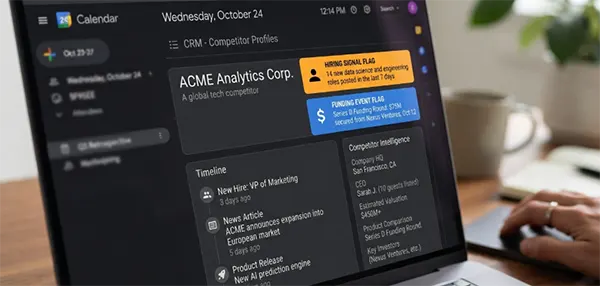
The majority of the signals are already present inside software, the tools that were built for prospecting. Which means that the documentation that tells a rep about the companies that just raised funding on their Series B round also tells that competitor exactly the same thing. The only difference is that the competitor and the rep perceive it as very different things. Hence, the signal remains the same; it’s the audience that changes.
Even the platforms that were built to show people which company has raised their funding, like LinkedIn Sales Navigator and Gong, were actually never built to make this data visible to a competitor, and hence their marketing strategy was never built around these features. But that’s the thing: even though these software tools were not built for this feature, this feature can still be used by the competitors, and the signal does not know how to differentiate between the two.
These guides actually are much more transparent when it comes to competitor research. This is because while these guides perfectly rank what platforms are useful, they only do so based on what each type of data actually contains after sorting it through categories. This means it places the data stored inside categories like intent, trigger events, firmographics, and more, which are the exact things a competitor needs to know to understand your company’s plans.
From Data Points to Decisions
Most people do not realise this, but there is a huge difference between data and intelligence. Confusing the two is actually where most companies lose their budget. For example, a vendor who documents the same contact records in every quarter is not collecting intelligence because this will not help him make any decision about his business or even tell him anything about the competitor’s business. All he is doing is collecting repetitive data, which makes him feel like he is actually doing work when in fact he is not.
An activity can only be assigned as intelligence when, after reading a particular signal, someone on a schedule actually takes a decision about it. Most companies actually collect competitive intelligence accurately, but that data is not assigned for anyone to read, and most of it goes unreviewed and is not useful. Reading such data can actually tell you a lot more about the company and what it needs, like when the next hiring spike should be or what a tech-stack swap actually means for this quarter’s plan.
The best approach to solve this is by assigning someone to actually read this data when each quarter of the company is actually coming to an end. Thus, just a fifteen-minute review and a named owner can help you understand this data better than collecting more of it can.
Most people actually go for a different option, which is that they buy a different tool without ever actually thinking about who is going to read it. While this gives you a wider scope of data, it does not necessarily ensure that it would be useful. Because unless anyone actually reads that data, it is just a bunch of numbers.
Where the Appetite for This Spreads
This usually starts on a much narrower scale than most people think.
Once a company or a team actually starts analysing their competitor signals and actions through software and reviews, it rarely ever stays to one part of the company like sales. It travels to different spheres like marketing, finance, operations, and more.
So marketing now wants to know what the previous changes were that its competitor made in how people perceive their brand, basically their messaging. Product teams want signals about the new features that were incorporated into a product or the previous ones that were removed. And finance wants to know what is going to cause the company to keep watching these signals. Scaling a team to match that appetite is its own separate problem, and departmental expansion usually means mapping the new roles before hiring for them, not after.
It rarely stays a one-department habit for long.
Why Finance Teams Ask for the Business Case
Any tool or software that has a retainer-based payment model eventually always lands on the review of a finance team. This is because they have to check whether the tool is actually used or if it is just another liability that the company is quietly paying for. So sales intelligence platforms are no exception; they get questioned the same way an automation tool would.
The difference that is actually worth knowing is already occurring in the same department that is questioning every other tool and whether it’s worth it or not. This means that it was observed that automating invoice capture, which matched bank feed, actually helped save 500 hours a year in finance operations. However, this did include some of the staff spending at least 10 hours a week on manual processing for the capture.
And that is how the bill is judged. Because the sales subscription that offers a vague promise of better visibility is usually not signed off by the finance team as an asset, but sales intelligence software that helps automate processes and hence save the teams time so that they have time to focus on better things is always considered a benefit by the finance team.
Competitors Are Showing Up Somewhere Else Too
Back in the day, competitors only used to reach out for the search result pages, which is SEO automation to carry out the competitor research. However, the game has entirely changed now.
Earlier, Google search engines actually gave you multiple sources of options, and the one most people clicked was the one that was present at the top. But now, with AI coming in, answer engines break a question into several small sub-questions before they assemble a response. And the brand that gets cited in that response actually depends on multiple factors rather than the usual SEO automation. Today, this brand visibility is achieved by signals most sales teams have never heard of — site focus, off-site mentions, whether the specs sit in parseable HTML instead of a PDF.
So this part is not just optional anymore; it is the feature that makes sure that your brand actually survives. This feature is known as Generative Engine Optimization or GEO. This feature is extremely important for brand visibility, and the competitor that wins this fight is quietly preparing for a channel that your sales team does not track and does not even know exists.
The Same Decision Shows up in Link Building Too
This buy-the-data-or-do-it-by-hand decision isn’t unique to sales.
SEO teams run into the identical trade-off with backlink research. Tracking prospects and outreach by hand works at a handful of links a month, and stops working well before a hundred. The usual fix is dedicated backlink-tracking software, a category that, like sales intelligence platforms, exists mainly to turn a manual lookup into a dashboard somebody actually checks on a schedule.
The Habit That Actually Pays for the Subscription
Now most companies assume that to function effectively and in a much better way, they need different tools to do it.
However, that is far from reality. What most companies actually need in the end is for someone to review the data that is already being collected and make a decision on it. This means that assigning a person to review the data and decide what last week’s hiring signal or price-in signal actually means is a much better way to use the data rather than just collecting it and never reaching for it again.
This is a much cheaper fix than buying different tools, which is what most people opt for. This happens because buying another tool that helps you collect data feels like progress, whereas a 15-minute review every week does not. But only one of them is approved by a finance team.
Read what you already have. Buy the second tool later, if you still need it.
Frequently Asked Questions
Do we need a dedicated competitive-intelligence tool, or can sales intelligence data cover ,it?
How often should competitor signals actually get reviewed?
Weekly is enough for most teams. Daily checking usually just means someone’s watching instead of acting, and monthly is often too slow to catch a pricing or staffing shift while it still matters.
Which signal matters most if we can only track one?
Hiring signals tend to lead the others — a competitor staffing up in a function usually shows intent before the pricing page or messaging catches up.
Does this replace talking to prospects about competitors directly?
No. A prospect on a call will tell you things no dashboard catches, like which feature actually lost them sleep. Data fills the gaps between those conversations; it doesn’t replace them.
Related Posts
Search Console Forgets Everything After 16 Months: How to Back Up Your SEO Data
After completing the period of 16 months, all the data and access are deleted from Google Search Console’s database. After…
Why Digital Transformation Projects Stall: A Resourcing Playbook for Project Managers
Digital transformation projects are on the rise at this time. From government-backed initiatives to enterprise cloud adoption and AI integration.…
How Email Hosting Providers Store and Protect Business Data
Where does your business email go when you click the send button? The impression is that the email just goes…
Best CI/CD Platforms for Coding Agents and AI-Native Development
CI/CD has changed its job because coding agents now write a growing share of the changes that reach a repository.…

Mavlers Agency on Why Global Agencies Are Turning to Offshore SEO Teams
An offshore SEO team in India is becoming more and more an option for great profit for global agencies; it’s…
How to Change Signature in Outlook: A Complete Guide
How do you change signature in Outlook? It sounds simple until you realize that the steps vary across Windows, Mac,…
Best 7 AI Development Companies for Data AI Solutions for Your Project: Guide for…
Buying model work before the data work is the most expensive order to do it in. The pilot shows well,…
Top Software Development Companies Backed by GoodFirms Reviews
In September 2026, GoodFirms listed 853 software development companies in California. The group had a median hourly rate of $37,…

What Is a Blockchain Explorer? How to Track Crypto Transactions
A blockchain explorer is a searchable interface for viewing data recorded on a public blockchain. You can look up a…